
Published April 21, 2026
Ecommerce Chatbot: Boost Sales & Automate Support
5 min read

Amandine Cami
Commercial Director

Table of contents
Have questions or want a demo?
We're here to help! Click the button below and we'll be in touch.
Get a Demo
AI Summary by QAnswer
An ecommerce chatbot is no longer a novelty feature — it is core conversion infrastructure for online retailers. The right chatbot reduces cart abandonment, answers product questions instantly, automates post-purchase support, and recovers customers who would otherwise leave your store without buying.
This guide covers everything you need to know about ecommerce chatbots in 2026: what they do, which types deliver the most value, and how to deploy one that actually converts.
What Is an Ecommerce Chatbot?
An ecommerce chatbot is an AI-powered assistant embedded in your online store that converses with shoppers in real time. It answers questions about products, shipping, returns, and account management — and in more advanced deployments, it proactively guides users through the purchase funnel, recommends products, and completes transactions autonomously.
Modern ecommerce chatbots are powered by large language models (LLMs) and trained on your product catalogue, FAQ content, and store policies — giving accurate, personalised answers rather than generic scripted responses. To get the most out of your chatbot, learn how to train an AI assistant on your own data.
Why Ecommerce Businesses Need AI Chatbots in 2026
Online shoppers abandon carts at a rate of approximately 70% globally. A significant proportion of those abandonments are driven by unanswered questions — about product specs, sizing, delivery times, or return policies — that could have been resolved in seconds with the right chatbot.
- Instant product Q&A — Answer questions about specifications, compatibility, availability, and pricing without waiting for a support agent.
- Cart recovery — Proactively re-engage visitors who are about to exit with relevant product information or offers.
- Order status automation — Handle the most common post-purchase query ("Where is my order?") without a human agent touching it.
- Returns and refunds guidance — Guide customers through the returns process automatically, reducing support volume and customer frustration.
- Personalised recommendations — Suggest complementary products based on what the customer is viewing or their purchase history.
- 24/7 availability — Serve customers in every time zone, including at 2 AM on a Sunday when a sales rep is not available.
Types of Ecommerce Chatbots
FAQ and Policy Bots
The simplest category: chatbots trained to answer your store's most common questions about shipping, returns, sizing, and policies. Low complexity, high ROI for support ticket deflection.
Product Discovery and Recommendation Bots
These chatbots act as virtual shopping assistants — asking preference questions, interpreting natural language descriptions, and returning a curated set of options from your catalogue.
Transactional Agents
The most advanced category: bots that complete actions on behalf of the customer — updating shipping addresses, processing returns, applying discount codes, and even completing checkout. These require deeper platform integration and careful human-in-the-loop design for high-value actions.
Key Features to Look for in an Ecommerce Chatbot
- Product catalogue integration — The bot must have access to your live inventory, pricing, and product descriptions.
- Order management system connectivity — Essential for post-purchase queries about shipping status, returns, and refunds.
- Natural language understanding — Shoppers describe products in their own language; the bot must understand intent, not just keywords.
- Proactive engagement triggers — The ability to initiate conversations based on user behaviour (exit intent, time on product page, cart size).
- Multilingual support — If you sell internationally, your chatbot must respond fluently in your customers' languages.
- Handoff to human agents — A clear, seamless escalation path for complex complaints or high-value queries. For a broader view of available options, see our roundup of the best AI tools for customer support.
How to Set Up an Ecommerce Chatbot
- Define your use cases — Start with your top 10 most frequent support questions.
- Connect your data sources — Product catalogue, FAQ pages, shipping and returns policies, order management system.
- Configure conversation flows — Design how the bot handles edge cases: out-of-stock products, international shipping restrictions, escalation triggers.
- Set up proactive triggers — Configure when the bot proactively initiates a conversation (exit intent, idle time, cart abandonment).
- Test with real user scenarios — Run through your most common customer journeys before going live.
- Monitor and optimise — Review unanswered questions weekly and update your knowledge base with new products and policies.
Ecommerce Chatbot ROI: What to Expect
- 20–35% reduction in support ticket volume for businesses that deploy chatbots trained on their full FAQ and policy content.
- 15–25% improvement in conversion rate for product pages where a chatbot proactively answers questions.
- 50–70% of post-purchase queries resolved without human intervention.
- Significant CSAT improvement driven by instant response times, particularly outside business hours.
How QAnswer Powers Ecommerce Chatbots
QAnswer is particularly well suited for ecommerce businesses with large, complex product catalogues or those operating in regulated categories (pharmaceuticals, financial services, food and beverage) where answer accuracy is paramount.
- Deep product knowledge integration — Connect your product database, catalogue feeds, and documentation so the chatbot answers with precision about specifications, compatibility, certifications, and availability.
- Policy and FAQ grounding — Train the bot on your shipping, returns, warranty, and compliance documentation. Every answer is cited back to your verified policies — critical for regulated products.
- Multilingual storefront support — QAnswer supports 30+ languages natively, enabling a single deployment to serve your full international customer base.
- Sovereign data handling — If your ecommerce store handles sensitive customer or health-related data, QAnswer's on-premise deployment keeps everything entirely within your infrastructure.
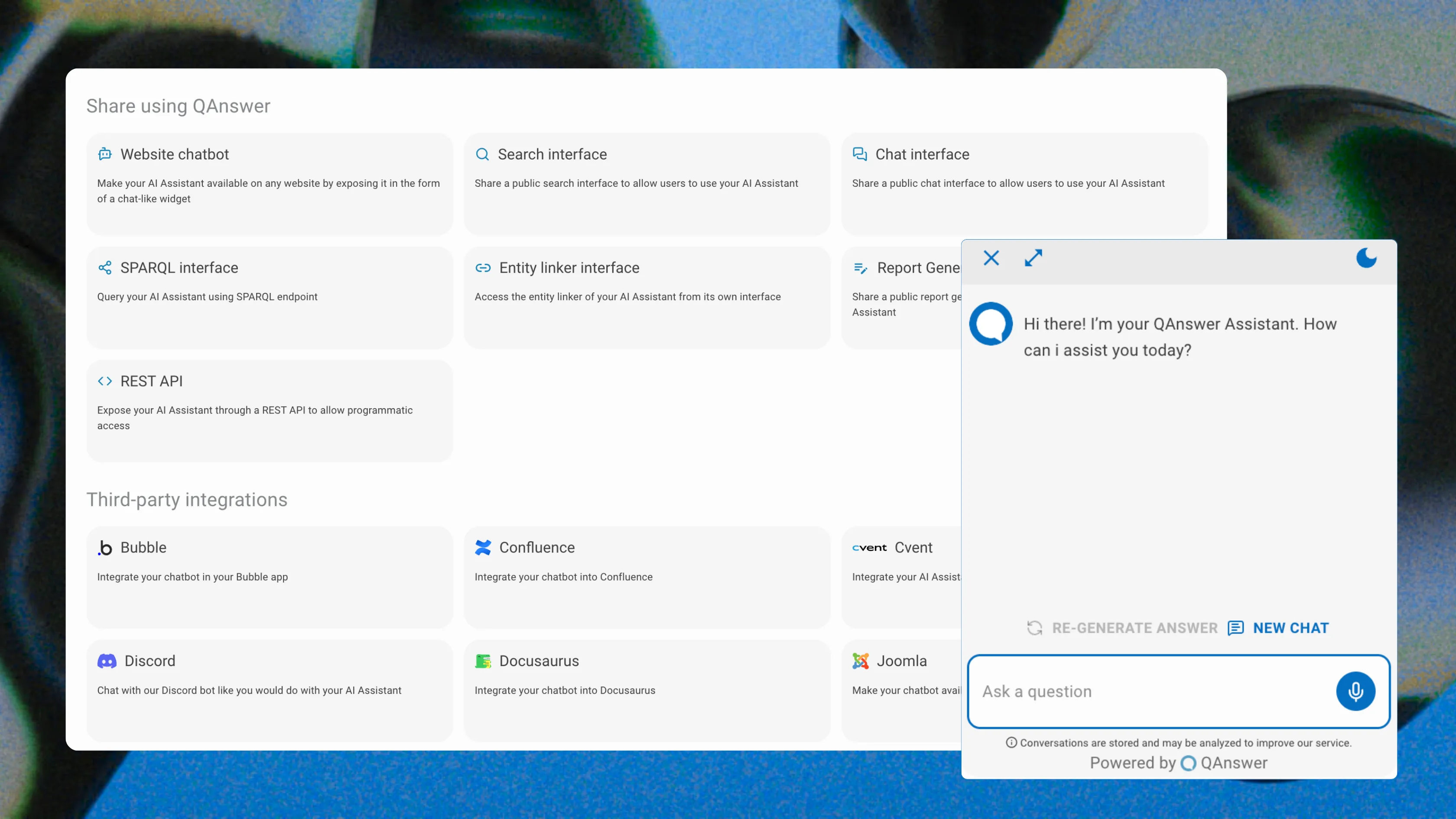
- API-first integration — Connect QAnswer to Shopify, Magento, WooCommerce, or custom-built platforms via REST API with no platform-specific plugin required.
Conclusion
An ecommerce chatbot trained on your actual product catalogue, inventory, and policies is one of the most cost-effective investments you can make in your online store. It reduces support costs, recovers lost conversions, and serves your customers with the accuracy and availability that modern shoppers demand. Learn more about how generative AI is transforming customer service across industries.
Want to see a QAnswer-powered ecommerce chatbot in action? Book a demo using your own product catalogue and watch it answer your toughest product questions.
Back to Blog
The AI platform that works.
Try for free today