
Published April 21, 2026
Generative AI for Sales: How to Close More Deals in 2026
5 min read

Amandine Cami
Commercial Director

Table of contents
Have questions or want a demo?
We're here to help! Click the button below and we'll be in touch.
Get a Demo
AI Summary by QAnswer
Sales is one of the highest-leverage applications for generative AI. From researching prospects and personalising outreach at scale, to coaching reps in real time and analysing pipeline health, generative AI for sales is enabling teams to do more with fewer resources — and close deals faster.
This guide explains the practical ways generative AI is transforming B2B and B2C sales in 2026, what to implement first, and how to build a generative AI sales stack that actually increases revenue.
What Is Generative AI for Sales?
Generative AI for sales refers to the use of large language models (LLMs) to augment and automate tasks across the sales cycle — from prospecting and outreach, through qualification and discovery, to proposal writing and pipeline management. Unlike basic CRM automation, generative AI understands context, generates human-quality language, and adapts to the nuances of each deal.
Key Use Cases for Generative AI in Sales
Personalised Outreach at Scale
Writing a genuinely personalised cold email used to take 20 minutes per prospect. Generative AI reduces this to seconds. By combining CRM data, company news, and industry context, AI generates outreach that reads as if it was written specifically for that recipient — because functionally, it was.
Prospect Research and Intelligence
Before a discovery call, reps need to understand the prospect's business, pain points, recent news, and relevant buying signals. Generative AI agents compile this research in seconds, synthesising public and internal data into a structured briefing document.
AI-Powered Sales Conversations
Chatbots and AI assistants on your website qualify inbound leads 24/7 — asking discovery questions, scoring responses against your ICP criteria, and routing high-value prospects to a human rep in real time. See our dedicated guide on lead generation chatbots for implementation details. Generative AI handles the conversation naturally, without feeling scripted.
Proposal and Quote Generation
Generative AI drafts tailored proposals, pulling in relevant case studies, pricing configurations, and technical specifications from your internal knowledge base. Sales engineers spend less time on document assembly and more time on strategic deal work.
Sales Coaching and Call Analysis
AI transcribes and analyses sales calls — identifying objections raised, competitor mentions, sentiment shifts, and coaching opportunities. Managers get scalable visibility across the team; reps get immediate feedback on what to do differently.
Pipeline and Forecast Analysis
Generative AI analyses CRM data and deal notes to identify at-risk opportunities, flag stalled deals, and provide a conversational interface to your pipeline data — enabling sales leaders to query their pipeline in plain language.
Benefits of Generative AI for Sales Teams
- Higher rep productivity — Automating research, writing, and data entry frees reps to spend more time in conversations.
- Better personalisation at scale — AI maintains the quality of personalised outreach even as volume grows.
- Faster deal cycles — AI-assisted qualification, proposal generation, and objection handling accelerates every stage.
- Consistent messaging — Generative AI enforces brand and compliance guidelines across all outreach and proposals.
- Improved conversion rates — Chatbots that qualify leads 24/7 capture pipeline that would otherwise go dark overnight.
How to Implement Generative AI for Sales
- Identify your highest-leverage friction point — Is it outreach volume? Proposal quality? Lead qualification? Start with one use case.
- Connect your sales knowledge base — Product documentation, case studies, pricing sheets, objection-handling guides, and competitor battle cards should all be accessible to your AI tools. Learn how to train an AI assistant on your own data.
- Integrate with your CRM — AI sales tools derive much of their value from CRM data. The tighter the integration, the more personalised and context-aware the outputs.
- Define guardrails — Not every AI-generated email should go out without review. Establish approval workflows for high-stakes communications.
- Measure impact rigorously — Track open rates, reply rates, meeting-to-close ratios, and time-to-proposal before and after deployment.
How QAnswer Supports Generative AI for Sales
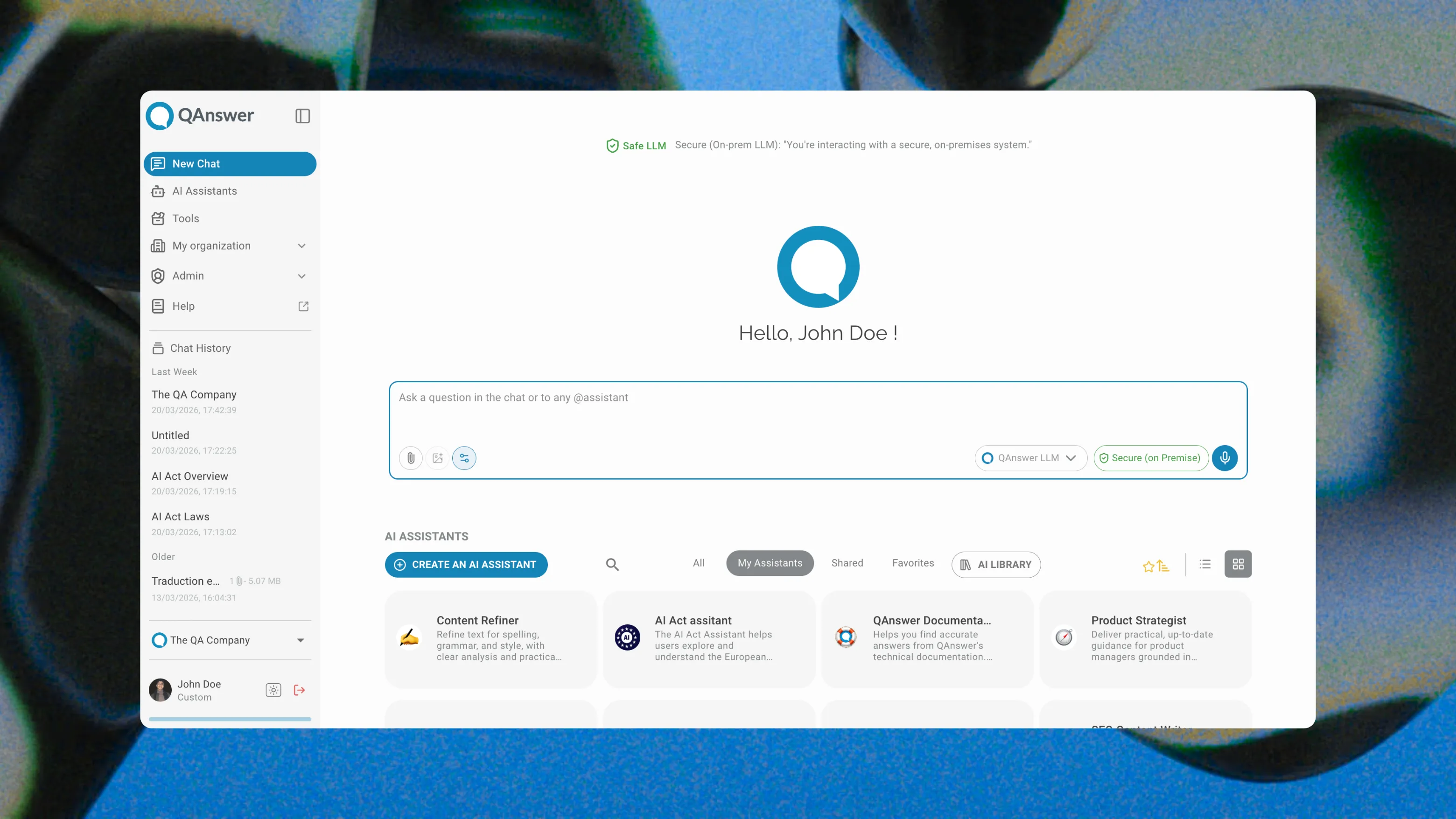
One of the most underutilised opportunities in sales is the knowledge your organisation already has: product documentation, case studies, technical specifications, pricing guides, and objection-handling playbooks. QAnswer turns that internal knowledge into an active sales asset.
- AI sales assistant on your website — Qualify inbound prospects 24/7, answer complex product questions, and route high-value leads to the right rep — all grounded in your actual product knowledge, not a generic LLM.
- Internal knowledge assistant for reps — Reps ask questions in plain language ("What do we say when a prospect raises GDPR concerns?") and get instant, accurate answers drawn from your sales playbook and policy documents.
- Accurate, on-brand proposal generation — QAnswer retrieves the right case studies, technical specs, and pricing configurations from your internal knowledge base and assembles them into a proposal draft in seconds. Explore the full range of enterprise chatbot use cases that complement your sales process.
- Automatic knowledge currency — When your product roadmap changes or new case studies are published, QAnswer re-indexes your content automatically — ensuring your AI sales tools always have the latest information.
- Sovereign deployment — Your sales intelligence, customer data, and competitive information never leave your infrastructure. ISO 27001 certified.
Conclusion
Generative AI for sales is not about replacing sales reps — it is about making them significantly more effective. The teams that invest in AI-assisted research, outreach, qualification, and proposal generation will consistently outperform those that rely on manual processes. If you sell online, an ecommerce chatbot is one of the fastest ways to put these capabilities to work.
The highest-impact starting point is building a knowledge-grounded AI sales assistant — one that knows your products, your policies, and your positioning inside out. That is exactly what QAnswer is built to do.
Ready to deploy generative AI across your sales process? Get a QAnswer demo tailored to your sales use case.
Back to Blog
The AI platform that works.
Try for free today