
Published April 21, 2026
Agentic AI vs Generative AI: Key Differences (2026)
6 min read

Amandine Cami
Commercial Director

Table of contents
Have questions or want a demo?
We're here to help! Click the button below and we'll be in touch.
Get a Demo
AI Summary by QAnswer
The terms agentic AI and generative AI are often used interchangeably — but they describe fundamentally different capabilities. Understanding the distinction matters enormously when you are deciding which AI technology to invest in, and how to deploy it safely inside your organisation. Once you have chosen your approach, our step-by-step guide on how to build an AI agent will take you from concept to production.
This guide explains what agentic AI and generative AI each mean, how they differ, where they overlap, and how to decide which approach — or which combination — is right for your use case.
What Is Generative AI?
Generative AI refers to AI models trained to generate new content — text, images, code, audio — in response to a prompt. Large language models (LLMs) like GPT-4, Claude 3, and Llama 4 are the most prominent examples. When you type a question into ChatGPT and receive a written answer, you are using generative AI.
Generative AI is primarily reactive. It takes an input, processes it through a trained neural network, and produces an output. It does not plan across multiple steps, take actions in external systems, or monitor outcomes over time without additional architecture on top.
What Generative AI Is Good At
- Drafting text: emails, reports, code, summaries
- Answering questions from a knowledge base (with RAG)
- Translating, classifying, and transforming content
- Generating structured data from unstructured inputs
What Is Agentic AI?
Agentic AI describes AI systems that can pursue goals across multiple steps, use tools, maintain memory, and take actions in the world — not just generate text in response to a single prompt. An agentic AI system plans a sequence of actions, executes them, observes the results, and adapts its approach accordingly.
A simple example: a generative AI answers the question "What are our top three customers by revenue this year?" An agentic AI, given the same goal, queries your CRM database, cross-references your ERP data, generates a ranked list, and drafts a summary report — autonomously, without step-by-step human instruction.
What Agentic AI Is Good At
- Multi-step task completion across tools and systems
- Autonomous research, synthesis, and decision-making
- Process orchestration: triggering actions in CRMs, ERPs, APIs
- Continuous monitoring and adaptive response
Agentic AI vs Generative AI: The Key Differences
| Dimension | Generative AI | Agentic AI |
|---|---|---|
| Core capability | Generate content from a prompt | Plan and execute multi-step goals |
| Interaction model | Single prompt → single output | Goal → sequence of actions → outcome |
| Tool use | No (unless extended with plugins) | Yes — queries APIs, databases, web |
| Memory | Limited to context window | Persistent across sessions and tasks |
| Autonomy | Low — requires human prompting for each step | High — operates with minimal human intervention |
| Primary risk | Hallucination, outdated knowledge | Unintended actions, runaway loops, data exposure |
How Agentic AI Builds on Generative AI
Agentic AI does not replace generative AI — it extends it. At the core of every AI agent is a generative model that handles reasoning and language understanding. The agentic layer adds:
- Planning — breaking a goal into a sequence of steps
- Tool calling — querying APIs, running code, reading and writing files
- Memory — storing context from earlier in the session or across sessions
- Reflection — evaluating the results of previous actions and adjusting the plan
Think of generative AI as the brain, and agentic AI as the complete cognitive system that can act on the world.
Real-World Examples: Agentic AI vs Generative AI
Customer Support
Generative AI: A customer asks "What is your returns policy?" The chatbot retrieves the relevant section from the knowledge base and generates a clear answer. This is the foundation of generative AI in customer service.
Agentic AI: A customer asks "I would like to return order #4872." The agent retrieves the order from the CRM, checks the return eligibility rules, generates a pre-filled return label, updates the order status, and sends a confirmation email — all in one interaction.
Internal Knowledge Management
Generative AI: An employee asks "What is our data retention policy?" The AI searches the document store and provides an accurate answer with a citation.
Agentic AI: A compliance officer asks the agent to review all contracts signed in 2024 and flag any that include data retention clauses conflicting with GDPR Article 17. The agent searches the contract repository, analyses each document, and produces a structured risk report.
Which Should You Invest In?
- Start with generative AI if your primary use case is answering questions, drafting content, or summarising information. This delivers value quickly with lower complexity and risk.
- Invest in agentic AI when you need to automate multi-step processes, take actions in external systems, or handle tasks that require memory and adaptive reasoning.
- Use both together for most enterprise deployments: a generative AI knowledge layer handles Q&A and content generation, while agentic capabilities handle process orchestration and tool use.
Governance and Safety Considerations
Agentic AI introduces risks that generative AI alone does not. Because agents take actions — not just generate text — the consequences of errors are amplified. Use a robust governance framework to manage access and audit trails. Best practices for safe agentic AI deployment:
- Human-in-the-loop checkpoints for irreversible actions (sending external communications, updating financial records, deleting data)
- Minimal permissions — grant agents only the access they need for a specific task
- Audit trails — log every action taken by every agent for compliance and debugging
- Fallback mechanisms — define what happens when an agent encounters an unexpected state
How QAnswer Bridges Generative and Agentic AI
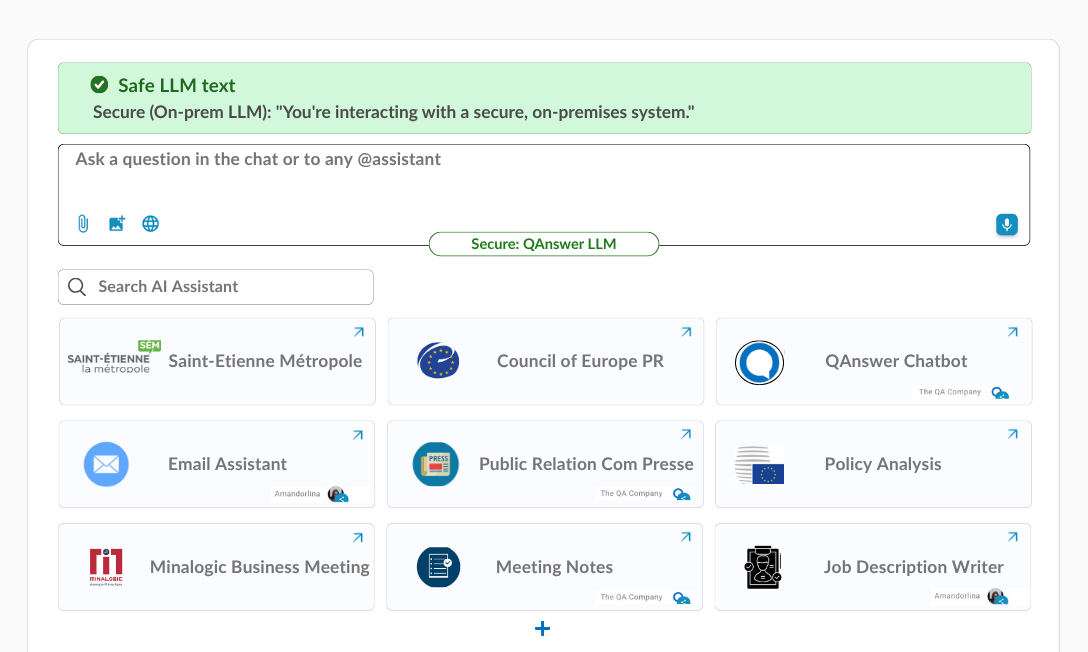
QAnswer is designed to deliver the benefits of both paradigms in a single, secure platform. At its core, QAnswer uses retrieval-augmented generative AI to answer questions accurately from your proprietary knowledge. On top of that foundation, QAnswer's agentic capabilities enable it to:
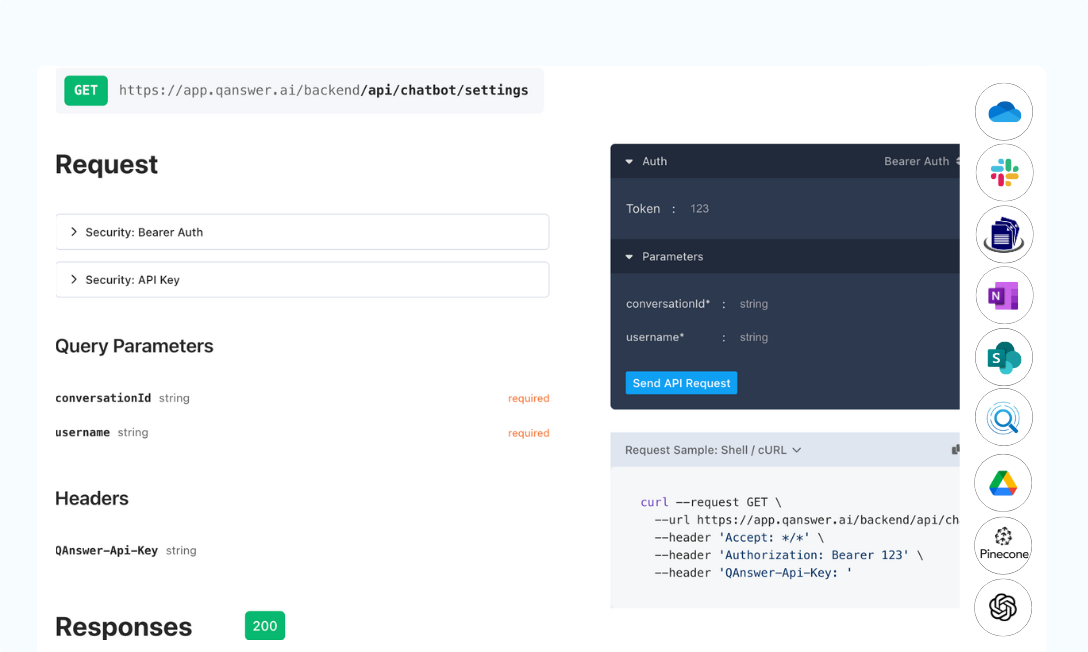
- Query multiple data sources in a single interaction — SharePoint, SQL databases, Confluence, REST APIs — and synthesise the results into a coherent answer.
- Execute multi-step research tasks — cross-referencing internal policies with regulatory documents and summarising the compliance implications.
- Integrate with enterprise workflows — triggering actions in connected systems (CRM updates, ticket creation, notification dispatch) based on conversation context.
- Maintain knowledge currency — automatically re-indexing connected data sources so the agent always works from up-to-date information.
Crucially, all of this runs within your infrastructure — ISO 27001 certified, on-premise or private cloud, with full audit logging.
Conclusion
Agentic AI and generative AI are not competing technologies — they are complementary layers of capability. The enterprises leading in AI adoption in 2026 are building stacks that leverage both, with robust governance frameworks to manage the elevated risks that agentic autonomy brings. For guidance on working with a specialist, see our guide on choosing an AI agent development company.
Want to explore how QAnswer combines generative and agentic AI within a sovereign, secure deployment? Request a demo and see how it handles real queries from your own knowledge base.
Back to Blog
The AI platform that works.
Try for free today